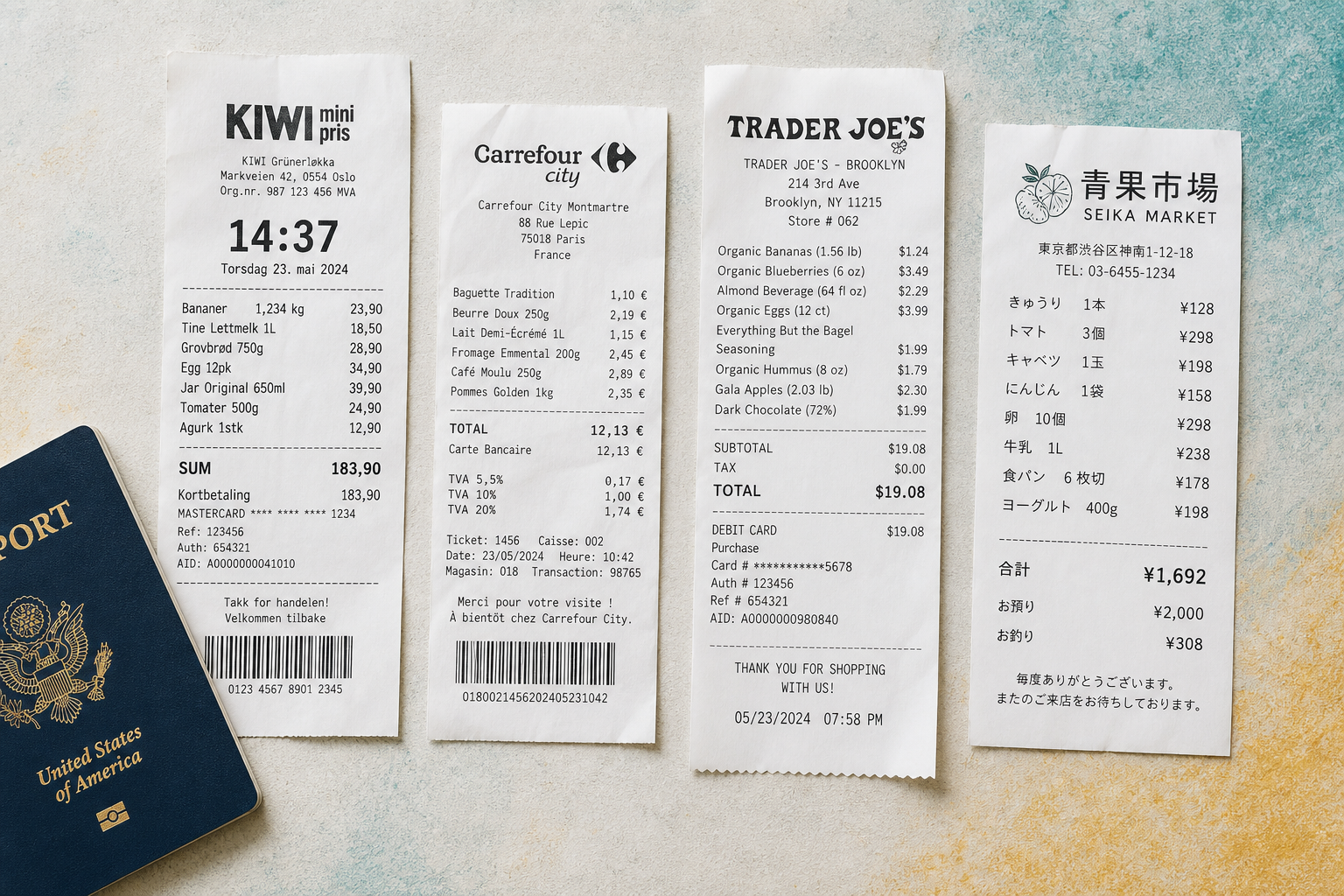
Where Your Grocery Receipt Prints the Time and Why It Matters
You probably never thought about it, but grab a receipt from your last grocery run and scan for the timestamp. Found it at the top? Buried halfway down? At the very bottom? Not there at all?
That little detail tells you more about the store’s priorities than any mission statement ever could. And when you’re traveling, understanding these patterns helps you navigate returns, expense tracking, and those awkward exit-door cart checks with a lot less friction.
American Supermarkets: Time Stamp at the Very Top
Walk into a Walmart, Kroger, or Safeway, and your receipt prints the transaction time right at the top, usually within the first three lines. This isn’t random design.
American chains prioritize loss prevention above almost everything else. When cart-checkers at the exit need to verify your purchase, they want instant confirmation. Top-line timestamps let them glance, compare to their watch, and wave you through without holding up the line. It’s efficiency theater that doubles as actual security.
Audit trails matter here too. If there’s a dispute about a transaction, managers can pull up records fast when the time is consistently positioned where everyone expects it. The system assumes you might be stopped, questioned, or need to prove when you bought something.
What This Means for You
If you’re shopping abroad in North American stores, keep that receipt visible when you exit. The timestamp placement tells you they’re watching. For expense reports or travel budgets, you’ll find your purchase time immediately, which makes logging purchases while jet-lagged much easier.
European Shops: Timestamp Buried Mid-Receipt
Pick up a receipt from Tesco, Carrefour, or Lidl, and you’ll scroll past loyalty program details, promotional offers, and savings summaries before you find the transaction time. It’s usually nestled somewhere in the middle, after the marketing content but before the payment method.
European retailers prioritize customer relationship data over security theater. They want you reading about your loyalty points, how much you saved, and what offers are coming next. The timestamp exists, but it’s not the star of the show.
This reflects a different retail philosophy. Stores assume you’re not going to be stopped at the door. They’d rather use that prime receipt real estate to reinforce your membership benefits and keep you coming back.
What This Means for You
When shopping in Europe, don’t expect quick exit verification. If you need to return something, be prepared to scroll past several sections to find your purchase time. Save digital copies if you’re tracking expenses, because that timestamp won’t jump out at you during a quick phone-photo review.
Asian Convenience Stores: Time at the Bottom
In Japan, South Korea, or Taiwan, grab a receipt from a 7-Eleven or FamilyMart. The timestamp sits at the very bottom, after the complete itemized list, after the total, sometimes even after the payment method.
This placement respects sequential information processing. You read through what you bought, see what you paid, then get the metadata. It matches cultural reading flow and serves customers who are often in a rush. Grab your items, glance at the total, fold the receipt, and go. The timestamp is there if you need it, but it doesn’t interrupt the primary information.
Convenience stores in these markets also assume high customer turnover and trust. There’s rarely an exit check, and returns are uncommon enough that timestamp accessibility isn’t a design priority.
What This Means for You
Shopping at Asian convenience stores? Your receipt is optimized for speed, not verification. If you need the timestamp for expense tracking, flip to the back or bottom. For returns, these stores often have stricter policies anyway, so the timestamp location matters less than keeping your receipt at all.
Discount Chains: No Timestamp At All
Some discount grocers print receipts with no timestamp whatsoever. You’ll see the date, maybe, but the specific time of purchase is absent.
This is cost-cutting and policy management rolled into one. Shorter receipts mean less thermal paper. No timestamp means customers can’t prove exactly when they bought something, which conveniently muddies return policy enforcement. If you claim you bought milk yesterday but the receipt only shows the date, the store can argue about freshness windows and time limits.
It’s a small omission with big implications. These stores have decided that saving pennies on paper and limiting accountability matters more than customer convenience.
What This Means for You
At discount chains abroad, photograph your receipt immediately if you think you might return something. Without a timestamp, you have less leverage. For expense tracking, you’ll need to note the approximate time yourself or rely solely on the date.
Why This Matters for Travelers
When you’re shopping in an unfamiliar country, receipt design tells you what to expect:
- Top timestamp? Prepare for exit checks and keep receipts handy.
- Mid-receipt time? Scroll past the marketing to find what you need.
- Bottom placement? Read sequentially and flip over if tracking expenses.
- No timestamp? Document purchases immediately and lower your return expectations.
These patterns aren’t universal laws, but they’re reliable enough that you can walk into a store, glance at a receipt, and understand the local retail priorities within seconds.
The Practical Takeaway
Receipt design is never accidental. Where stores place the timestamp reveals whether they prioritize theft prevention, customer retention, cultural reading patterns, or cost savings.
Next time you’re abroad and buying groceries for your Airbnb, check that receipt. The timestamp location will tell you whether to expect scrutiny at the exit, where to look when you need to return something, and how seriously the store takes accountability. It’s a small detail that makes navigating foreign retail a lot smoother.