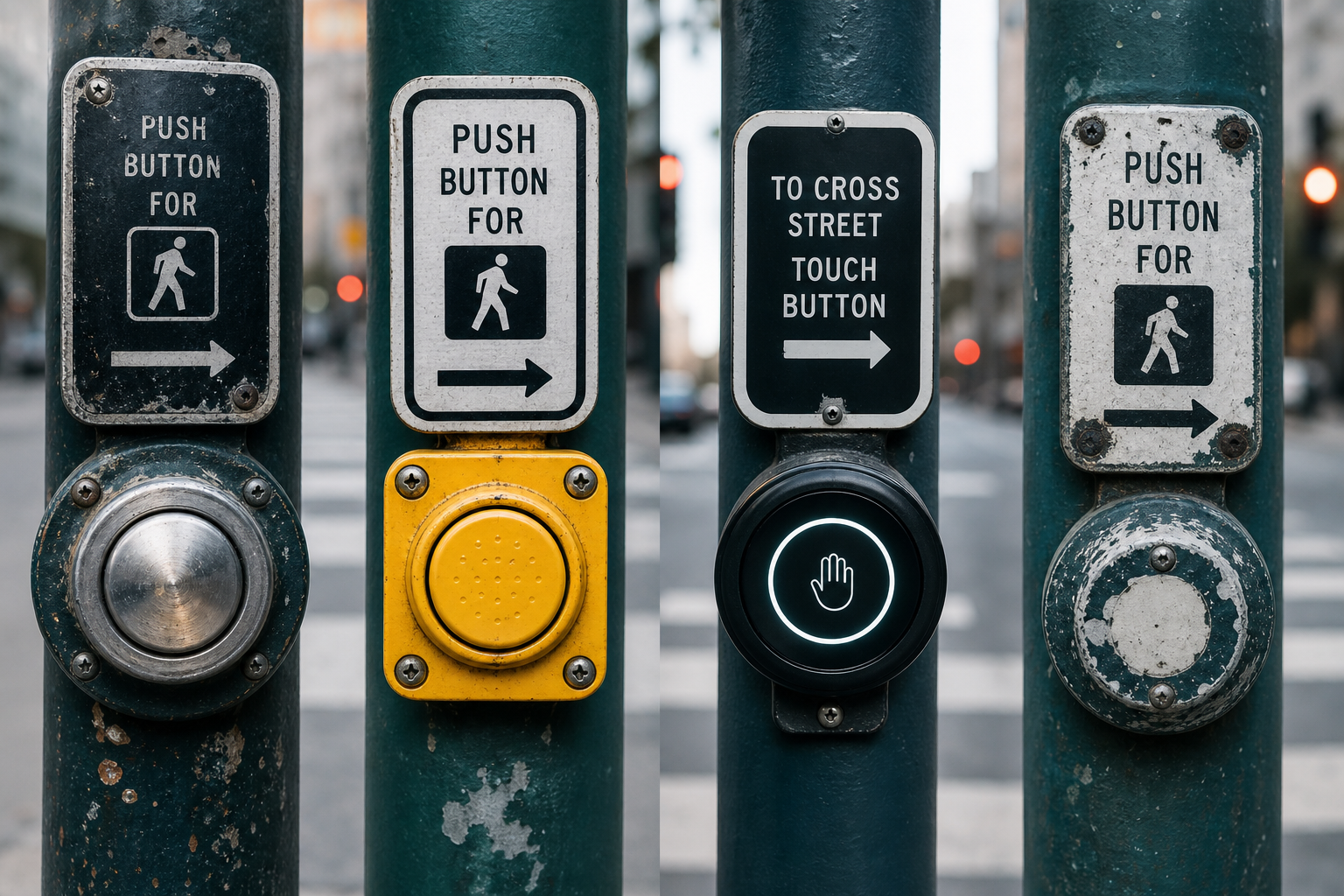
Why Pedestrian Crossing Buttons Work Differently in Every City
You’ve done it a thousand times. Arrived at a crosswalk, pressed the button, pressed it again for good measure, maybe one more time because surely that helps. But here’s the thing: in some cities, that button is listening. In others, it died years ago and nobody bothered to tell you.
The pedestrian crossing button is one of travel’s great overlooked tells. It reveals whether a city genuinely prioritizes walkers, engineers responsive infrastructure, or simply offers the comforting illusion of control. And once you know what you’re dealing with, you can stop wasting energy on dead hardware and start reading the city like a local.
New York: The Placebo Capital
In New York City, roughly 75% of pedestrian buttons do absolutely nothing. They’re connected to traffic lights running on fixed timers, pre-programmed cycles that don’t care how many times you jab that worn metal disc.
Why keep them? Because the illusion of control reduces complaint calls. City engineers discovered that people feel better when they have something to press, even when pressing changes nothing. It’s behavioral management disguised as infrastructure.
What this means for you: Stop pressing repeatedly. Watch the traffic pattern instead. New York crosswalks operate on predictable cycles, and learning to read the flow will get you across faster than hoping the button works.
London: Actual Responsiveness
Cross the Atlantic and everything changes. London’s pedestrian buttons actually trigger crossing phases, often within seconds. Press once, and the system acknowledges your request, integrating it into traffic flow that genuinely prioritizes foot traffic.
This isn’t accident. It’s engineered pedestrian priority, baked into urban planning that assumes people walk. The buttons feature tactile feedback, rotating cones for visually impaired users, and audible signals because the city designed infrastructure that actually responds to human needs.
What this means for you: Press once and trust. The system heard you. Pressing repeatedly doesn’t speed things up and marks you as a tourist who doesn’t understand how the city works.
Tokyo: Mathematical Precision
Tokyo takes a different approach entirely. Pedestrian buttons extend green time by precisely calculated seconds, based on crossing distance and assumed walking speed. The system doesn’t just respond, it calculates.
This reveals something fundamental about Japanese urban planning: trust in mathematical models and faith that pedestrians understand their own capabilities. Press the button and you’re telling the system you’ve measured the distance and know your pace. The city responds with exactly enough time, no buffer, no waste.
What this means for you: Press while calculating your pace. Don’t dawdle. The system gave you precisely what you need based on average walking speed, and the culture expects you to use that time efficiently.
Los Angeles: The Comfortable Lie
Los Angeles removed button functionality years ago in many intersections, but left the hardware intact. Why? Replacing signage costs more than maintaining the deception. You’re pressing a button that stopped working sometime around 2009, connected to nothing, acknowledged by no one.
This isn’t malice. It’s cost-benefit analysis in a car-first city where pedestrian infrastructure ranks low on budget priorities. The button remains because removing it requires paperwork, contractors, and money the city would rather spend elsewhere.
What this means for you: In LA, watch the traffic pattern and cross when safe, button or no button. The city designed itself around cars, and pedestrian infrastructure reflects that priority.
What Your City’s Buttons Reveal
These aren’t just engineering choices. They’re statements about urban values:
- New York prioritizes psychological comfort over transparency
- London engineers genuine pedestrian agency into infrastructure
- Tokyo trusts mathematical precision and pedestrian competence
- Los Angeles chooses budget efficiency over pedestrian experience
Each approach reveals what the city actually thinks about people on foot.
How to Read Any City’s Crosswalk System
Landing somewhere new? Here’s how to decode the local crossing culture:
- Press the button once and observe. Does anything light up, beep, or change?
- Watch locals. Do they press at all, or just wait for the cycle?
- Note the timing. Does the signal come quickly or after a fixed interval?
- Check for tactile or audio feedback, signs the system actually engages with pedestrians
Within a few crossings, you’ll know whether you’re dealing with responsive infrastructure, fixed timers, or expensive placebo hardware.
The Bottom Line
Pedestrian buttons are small things, easy to overlook in the rush of travel planning. But they tell you something honest about how a city works, what it values, and whether it designed itself for people on foot or people in cars.
Next time you press that button, pay attention to what happens next. The city just told you something true about itself. The question is whether you were listening.