What Airport Security Repack Zones Reveal About Travel Culture
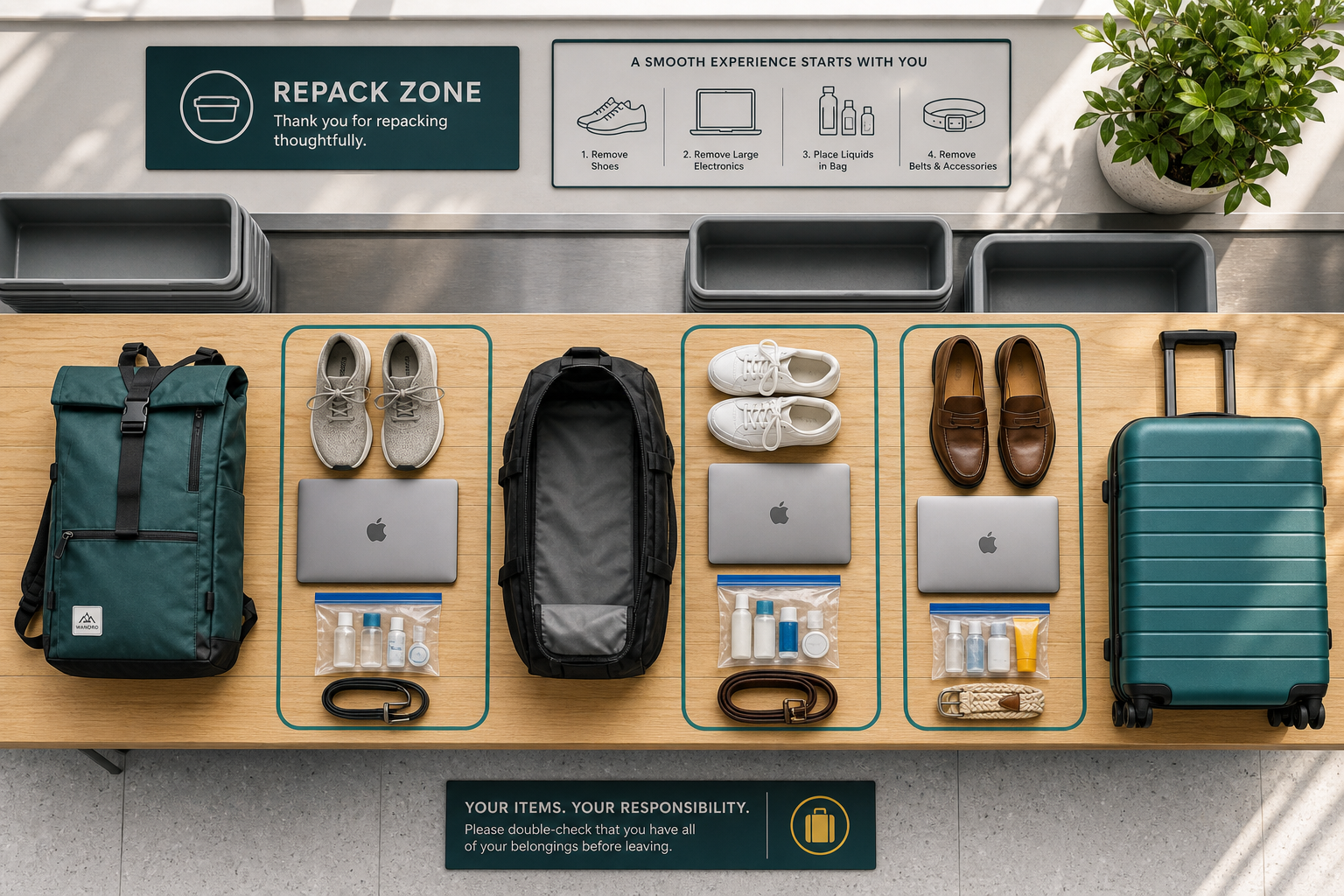
Stand in any airport security repack area for ten minutes and you’ll witness something more revealing than passport stamps: how different cultures approach the simple act of putting their belongings back together. The Japanese traveler who moves to a dedicated counter with provided trays. The American stuffing a laptop into a backpack while speed-walking toward the gate. The German using an entire bench to methodically reorganize. The Italian who’s somehow already at a cafe table, belt half-threaded, espresso ordered.
These aren’t random behaviors. They’re cultural packing philosophies on full display, and they’ll show up again throughout your entire trip.
The Repack Zone as Cultural Mirror
Airport security creates a forced unpacking moment that strips away the veneer of travel competence. Everyone’s belongings spill into those gray bins. Shoes off, liquids out, electronics separated. What happens in the sixty seconds after you clear the scanner tells you everything about how that culture relates to public space, efficiency, and personal organization.
In Tokyo’s Narita or Haneda, you’ll notice something immediately: nobody repacks at the conveyor belt. Travelers scoop their bins and move to dedicated counters along the wall, complete with provided trays for small items. They reconstruct their carry-ons with the same care they use to wrap gifts. Belts get coiled. Laptops return to padded sleeves. Nothing gets shoved.
This isn’t about being slow. It’s about not occupying shared space longer than necessary while still doing the job properly. That same logic appears later when you’re checking into a ryokan and watching guests remove shoes at the entrance without blocking the doorway, or when train passengers organize their belongings before the stop, not during.
Speed, Space, and the American Approach
Watch the repack zone at JFK or LAX and you’ll see the opposite priority: get out of the way by leaving entirely. Americans grab their bins, extract the essentials (phone, wallet, keys), and start walking while simultaneously threading belts, zipping bags, and checking boarding passes.
The repack happens in motion, often completed somewhere between security and the gate. Efficiency means clearing the immediate space fast, even if that means finishing the task elsewhere. There’s an assumption that personal organization is exactly that: personal. Handle it on your own time, in your own space.
You’ll see this philosophy again in American hotels, where guests treat rooms as private reorganization zones, spreading out completely. Or in restaurants, where people might check phones, repack bags, or reorganize wallets at the table without a second thought. The boundary between public and private leans heavily toward personal autonomy.
German Precision and the Bench Reorganization
Frankfurt and Munich security areas come equipped with long benches specifically designed for the full repack. German travelers use them exactly as intended: they claim a section of bench, lay out every item from their bins, and reassemble their luggage with systematic precision.
This isn’t about taking up space inconsiderately. The benches are there for this purpose, and using them properly means doing a thorough job. Laptop goes in its compartment. Liquids bag returns to its designated pocket. Belt gets threaded completely, not just hooked through two loops.
That same respect for doing things correctly, in the appropriate space, shows up when you’re navigating train stations (clear signage exists for a reason), hotel breakfast buffets (each item has its intended serving utensil), or even pedestrian crossings. There’s a right way to use shared infrastructure, and the repack bench teaches you that lesson early.
The Italian Cafe Table Solution
In Rome or Milan, a surprising number of travelers clear security and immediately veer toward the nearest cafe. They’ll claim a table, order an espresso, and repack while sitting down. Belt threading happens between sips. Boarding pass gets checked while the laptop finds its sleeve.
This approach treats the repack as a moment to pause rather than a task to complete. Why rush when you can sit, have a coffee, and handle your belongings in a civilized way? The security checkpoint was stressful enough.
You’ll recognize this philosophy throughout Italy: the mid-morning espresso break that’s non-negotiable, the long pause between lunch courses, the evening passeggiata that prioritizes presence over efficiency. Tasks get done, but they get woven into moments of enjoyment rather than rushed through to reach the next obligation.
What This Means for Your Trip Planning
Understanding these repack philosophies helps you anticipate cultural friction points before they happen. If you’re traveling to Japan, practice packing in a way that allows for quick, complete reassembly. You’ll need that skill for hotel checkouts, onsen changing rooms, and temple shoe removal areas.
Heading to Germany? Build buffer time into your itinerary for doing things properly rather than quickly. The culture rewards thoroughness, and you’ll enjoy your trip more if you’re not constantly cutting corners.
Planning an Italian journey? Accept that tasks will take longer than you expect, not because of inefficiency but because they’re integrated into social rituals. Fighting that rhythm creates stress. Adopting it creates memories.
The Lesson in the Bins
Next time you’re standing in an airport security repack zone, take sixty seconds to observe before you grab your bins. Watch how locals handle the transition from chaos back to order. Notice whether they prioritize speed or thoroughness, private space or public consideration, task completion or moment enjoyment.
That small ritual contains the entire cultural operating system you’re about to navigate. The traveler who learns to read those signals before boarding learns to move through destinations with less friction and more understanding. Your trip doesn’t start at the destination. It starts the moment you begin repacking your bag.