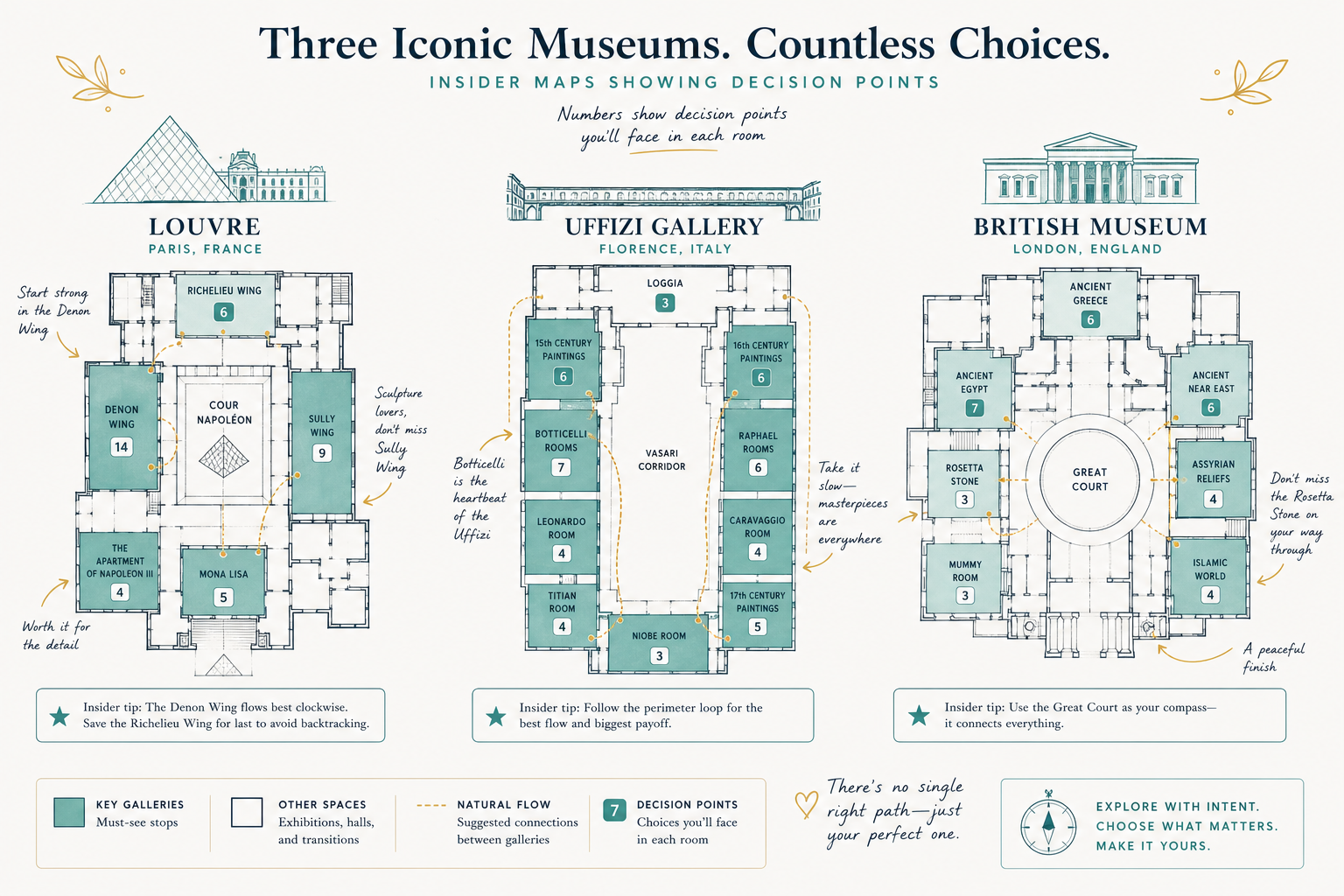
Museum Fatigue Isn’t About Walking, It’s Decision Load Per Room
You’ve planned the perfect morning at the Louvre. Early entry ticket, comfortable shoes, a mental map of the must-sees. Two hours later, you’re standing in front of a Caravaggio you’ve wanted to see for years, and you feel… nothing. Your brain has checked out.
Here’s the thing nobody tells you: museum fatigue isn’t about the kilometers you walk. It’s about the decisions you make in every single gallery room.
The Hidden Math of Museum Exhaustion
Every gallery room presents you with choices. Which painting deserves a closer look? Should you read that placard? Is this sculpture worth photographing? Do you circle back or move forward?
The numbers are staggering:
- The Louvre averages 47 decisions per room across 380 rooms
- The Uffizi presents about 31 decisions per room across 50 rooms
- The British Museum hits 52 decisions per room across 60 rooms
These aren’t just idle glances. These are cognitive moments where your brain evaluates, processes, and chooses. And each one costs you mental energy.
Your Personal Decision Threshold
Research on decision fatigue suggests most people can handle 80 to 120 meaningful choices before the quality of those decisions starts to decline. Some days you’re at the high end. Jet-lagged after a red-eye? You might be closer to 60.
Do the math for the Louvre: if you’re averaging 47 decisions per room, you hit decision fatigue after just 2 to 3 rooms. Yet most visitors try to cover 15 or 20 galleries because, well, you’re already there.
That glazed-over feeling in front of the Caravaggio? That’s not you being uncultured. That’s your prefrontal cortex waving a white flag.
Planning for Depth Instead of Coverage
This changes how you should plan a museum visit entirely. Instead of plotting a walking route that hits all the highlights, you need a decision budget.
Before You Go
Choose your cognitive focus areas. For the Louvre, that might mean:
- French Romantic paintings (Rooms 75-77)
- Mesopotamian antiquities (ground floor, Richelieu wing)
- Skip everything else, including the Mona Lisa crowd
Yes, skip things. Ruthlessly. You’re not going to remember 200 paintings you shuffled past anyway. You will remember the 45 minutes you spent with Delacroix, actually reading the context, noticing the brushwork, sitting with the emotional weight of the piece.
During Your Visit
Set a decision timer. After about 90 minutes of active looking and choosing (not walking between wings, actual gallery time), take a real break. Leave the building if you can. Your brain needs to reset.
When you return, you get another 90-minute decision window. Most people can do two of these in a day, maybe three if you’re fresh and the museum isn’t crowded.
The Three-Room Deep Dive Strategy
Here’s what works surprisingly well: pick three rooms. Just three. Spend 30 minutes in each.
In each room:
- Do a quick lap to see everything (5 minutes)
- Choose three to five pieces that genuinely interest you (2 minutes)
- Spend real time with those pieces, reading, observing, thinking (20 minutes)
- Take notes or photos only of those chosen pieces (3 minutes)
This approach respects your decision threshold. You’re making about 15 to 20 meaningful choices per room instead of 47. You leave with actual memories instead of a camera roll full of blurry paintings you don’t remember seeing.
When to Use Gallery Guides (and When to Ignore Them)
Audio guides and museum apps add decisions. Every time the guide prompts you to look at something, that’s another choice point: do I care about this or not?
Use guides for context in your chosen focus areas. Ignore them everywhere else. The paradox of museum technology is that it often increases decision load while promising to reduce it.
Different Museums, Different Strategies
Smaller, curated museums like the Frick Collection or the Musée Rodin have lower decision density. You can often see the whole thing without hitting decision fatigue because someone else did the editing for you.
Encyclopedic museums like the Met, the British Museum, or the Smithsonian require ruthless pre-planning. Treat them like cities, not buildings. You wouldn’t try to see all of Paris in one visit.
Your Museum Visit Checklist
Before your next major museum:
- Identify 2 to 4 specific galleries or themes you actually care about
- Check the decision density (room count times typical objects per room)
- Plan for 90-minute active viewing blocks with real breaks between
- Give yourself permission to skip 80% of the museum
- Book tickets for less crowded times (crowds multiply decision load)
The Takeaway
The best museum visits aren’t about seeing everything. They’re about seeing something deeply enough that it stays with you.
Next time you’re planning a museum day, don’t ask how much you can cover. Ask how much you can actually absorb. Count your decision budget, not your steps. Your future self, standing in front of that Caravaggio, will actually be present for the moment.
That’s the difference between tourism and experience.